Care Home Builders Leicestershire

We construct, expand, and renovate care facilities throughout Leicestershire, from new construction in Hinckley and Loughborough to renovations in Market Harborough and Melton Mowbray. Every aspect of our work is specific to the care industry. The designs, regulatory compliance, mechanical/electrical (M/E) systems and all design decisions are influenced by how care homes operate as opposed to being adapted from conventional building practices. If you are an owner/operator, developer, or investor for a care facility project in Leicestershire, this page will provide you with details of what we can do, an overview of the local care market, and why there is such a good opportunity to build or invest in the County at present.

Care Home Builders Leicestershire

What we do in Leicestershire

We provide a comprehensive, full-service design-and-build approach for our care sector clients across both city and county. Our services include:

Design & Build (New Build) Care Homes
We will assist in designing and developing a purpose-built care home from the early stages of project development through to completion as a fully commissioned, CQC-ready facility. Projects typically range from 40 to 80+ bedrooms, and we will take control of all aspects of the project - including Architecture, Structural Engineering, HTM/HBN Compliance, M&E Design, Fit-Out and Commissioning. The growth of Leicestershire's self-funded care home client base creates an opportunity to develop several new, larger, purpose-designed facilities. These types of developments are becoming increasingly popular within the UK marketplace; however, due to increased land costs in London and the South East, developing a similarly sized facility in Leicestershire offers a better economic return.

Refurbishment of Existing Care Homes
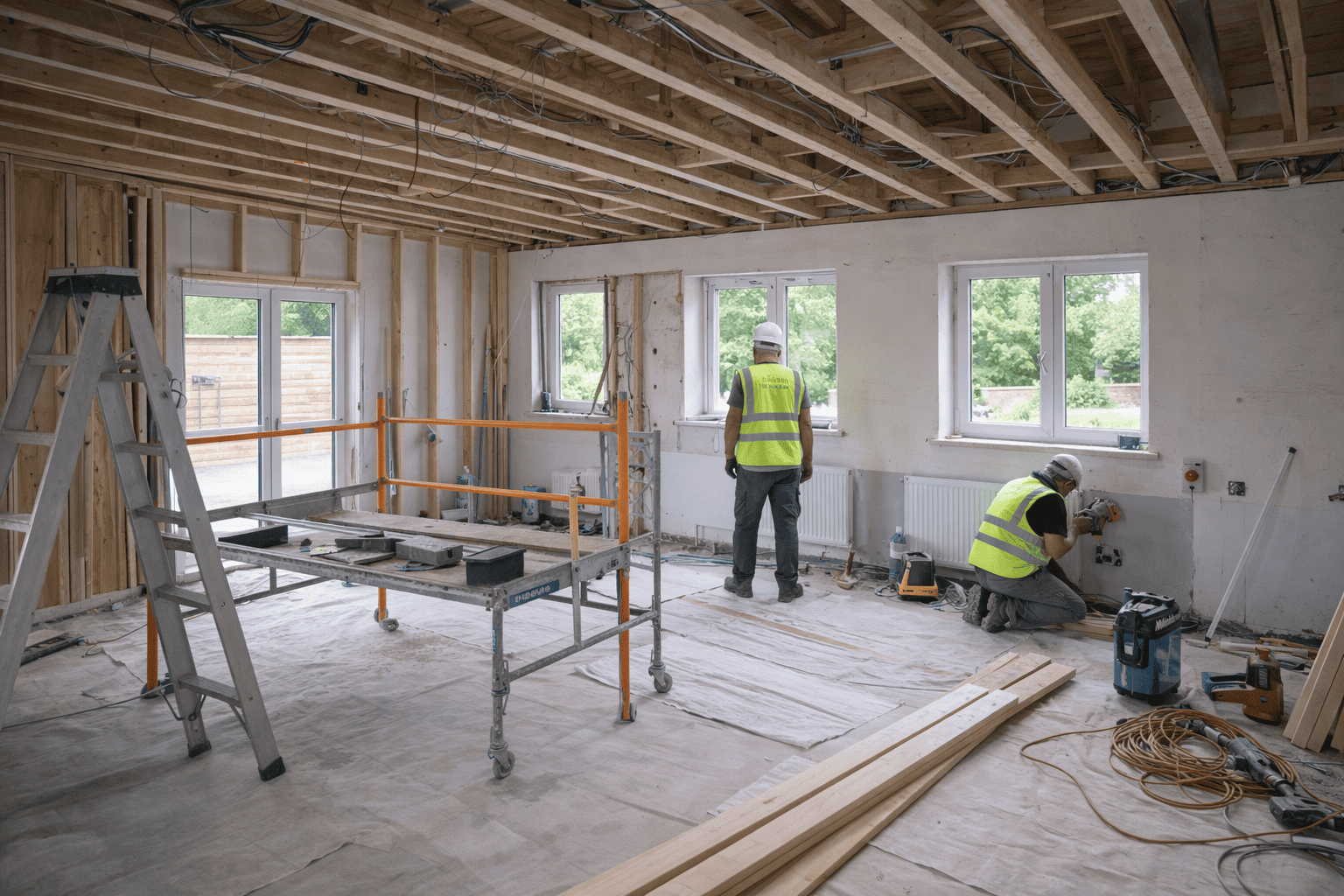
Much of Leicestershire's existing care home stock was developed during the 1980's and 90's - long before many of today's CQC Standards, Part M Accessibility Requirements, and Dementia Design Guidance were introduced. As such, much of the remaining stock is supported by outdated Mechanical Electrical Infrastructure (MEI) and poorly laid-out accommodation for both residents and staff. We undertake full or part-refurbishments at operational care homes: Wet Room Installations, Bedroom Upgrades, Fire Safety Improvements, Communal Space Redesigns, Kitchen Upgrades to HACCP-compliant standards, and Full MEI Overhaul. All of which are programmed to ensure minimal disruption to Residents and Care Delivery.

Extensions to Care Homes
Expanding a care home can be one of the quickest ways to add Registered Beds. You already have the Site, Planning History and Back Office Infrastructure. You do not have to purchase additional Land or establish a Care Management Office from Scratch - you are simply increasing Capacity within an already successful operation. Our team designs and delivers extensions that integrate seamlessly with the existing building. All additions are made to meet current CQC Bed numbers/Capacity Requirements and Part M Accessibility Standards. Wherever possible, we also phase extension works to enable continued operations whilst construction takes place. Our team work on sites located across Leicestershire - ranging from Urban Suburbs within the City of Leicester to Rural Town Centre Locations.

Dementia & Later Living
There is documented demand for Specialist Dementia Provision within Leicestershire. The County’s Market Sustainability Plan identifies a shortage of placements for People with Dementia & Complex Needs. Our team designs and builds Dementia Units/Later Living Facilities using layout principles that support Way Finding, Reduce Agitation, Provide Staff Sightlines, and Meet Evidence-Based Principles for Creating Dementia-Friendly Environments. This includes Material Selection, Lighting Levels & Garden Access, etc.

care-home-builders-leicestershire.png

The Leicestershire Care Market: What the Data Shows

A Strong Self-Funder Market and Growing Bed Capacity to Serve it 

Leicestershire is among the strongest self-funded older-adult care-home markets in the East Midlands. Approximately fifty per cent of all older adult care home beds in Leicestershire have been funded by self-funders; the proportion is much greater than in many similar counties. New entrants to the market (new homes) are deliberately designed to serve self-funders, and the County Council’s latest data show older adult bed stock increasing by thirteen per cent between June 2021 and June 2024. Those increases reflect what builders see: Leicestershire has both the demographic and financial resources to provide quality, affordable, purpose-designed accommodation. New buildings are generally larger and more modern than existing ones, reflecting a UK-wide trend toward larger, purpose-designed facilities for sixty-plus-year-olds.

Pressure Points and Opportunities in Nursing Care
The nursing care situation is more problematic. Since 2014, Leicester City has lost forty per cent of its nursing beds. Six nursing homes have closed; four others were de-registered for nursing care without replacement. This has been identified as a major problem by the City Council’s Market Sustainability Plan. Therefore, nursing placement availability is under considerable pressure. Specifically, there are shortages of nursing beds suitable for individuals who require complex care, dementia nursing, and hospital discharge. Residential care providers with nursing capability fill their beds faster than residential-only care providers. Therefore, whether a new facility should include some level of nursing care will affect the viability assessment of the development.

Occupancy and Available Beds
While average occupancy levels in Leicestershire may be reported as eighty-three per cent, which may suggest the market is relatively full, only approximately 750 beds across the county are currently vacant. This represents about fifteen per cent of the total number of beds available. There are several reasons why so many beds are unavailable. Firstly, many beds are reserved for patients requiring either NHS funding or complex care. Secondly, numerous homes are operating below their registered capacity due to staffing difficulties. Finally, many other operators manage waiting lists. Thus, while occupancy appears high, Leicestershire is essentially a very tight market, especially in nursing care.

Hospital Discharge Pressures and Dementia Shortages
The need to rapidly accept hospital discharge placements is a continuous concern for all parties involved in the Leicester, Leicestershire and Rutland Health Economy. While the County Council works closely with Health Partners to manage hospital discharges, it continues to face significant demand for beds that can accept urgent, high-acuity placements. In general, a new build or an extension with suitable clinical equipment — i.e., Nurse Call Systems, Assisted Bathrooms, etc., that is capable of accommodating rapid hospital discharge placements can generate additional NHS funding to supplement self-funder fees.
Additionally, the County Council has highlighted that there is now a specific shortage of dementia beds, although most care homes are reporting difficulty finding a place for individuals with even low-level dementia needs. As a consequence, many families are having to pay for specialist dementia care, rather than continuing to fund them within less expensive local authority-funded or non-authority-funded (i.e. self-funder) residential care settings. Thus, building a dementia-capable new build or extension would address a genuine gap in the local market.

Development Economics and Location
As previously stated, Leicestershire is centrally located in England, close to major motorways, including the M1 and M69, and connected via the A46. In addition, travel times from Leicester to London St Pancras International Station are under one and a quarter hours, providing access to all parts of the country. Accessibility matters for staff recruitment, visiting relatives/friends and ensuring continuity of supply lines throughout the construction period. Finally, land prices in Leicestershire are considerably lower than in areas such as the South East, thereby reducing overall development costs per unit and improving development viability.

care-home-construction-uk1.jpeg

How we work

The way that we do this is simple and as transparent as possible, right from the initial conversation through to handing over to you:

Stage 1: What happens
Initial Conversation: We have a discussion about your project, the site location, the types of services that will be provided at the site, how many beds there will be, how long it will take to complete, and how much it will cost. In our discussions with you, we will always tell you what can realistically be achieved on your project and where there may be some limitations on achieving everything you want.

Feasibility & Site Review - We review the site or existing building to see if the site/building would make a good place for your hospital/healthcare development and provide you with an accurate assessment of the site/building including its potential for use (viability), the planning environment in relation to the site/building, an estimated cost for the works and a rough timescale for completing them.

Design & Planning - Our team of healthcare architects will design the layout of your new hospital/healthcare development, ensuring compliance with all relevant national guidelines, including those set by the Care Quality Commission (CQC), Health Technical Memorandum (HTM) / Health Building Note (HBN) and Part M requirements. We will also assist in preparing and submitting the necessary documentation to obtain planning permission for your development.

Build & Project Management - We will manage every aspect of constructing your new hospital/healthcare development (Structural, Mechanical & Electrical (M&E), Fit-Out). We will assign a dedicated project manager who will ensure your project runs smoothly and report back to you regularly on its progress.

Handover & Commissioning - Once your new hospital/healthcare development has been completed, we will hand it over to you in a state ready for use and registration by the CQC. Following completion, we remain committed to providing ongoing support to you in terms of resolving any snags/issues, etc. related to your new hospital/healthcare development.

FAQ

Is the leicestershire self-funding care home market strong enough to accommodate a new luxury care home?

-

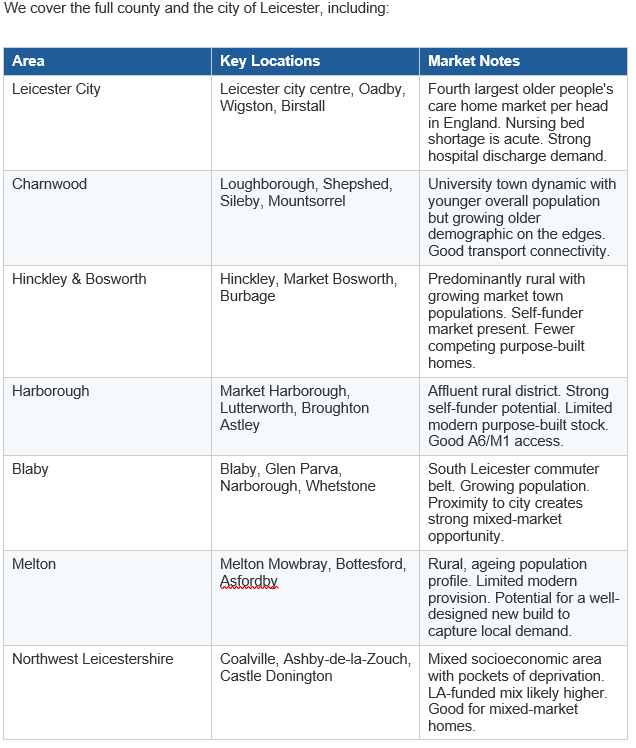
Yes, if the correct location. More than 50 per cent of Leicestershire's elderly adult care home bedplaces are currently funded by self-payers. The greatest potential for self-payers lies within the Harborough district and the most affluent areas of Charnwood and Blaby. As you go towards Coalville, or North Leicestershire, the market will transition to either LA-funded or a combination of both, and while this can work, the fee rates and feasibility figures will be quite different. We can assist you in determining the financial feasibility for your chosen location.

Doesn't Leicestershire have 83% occupancy? Isn't that a good indicator of how well provided for it is?

-

The headline figure does not tell us much. The county's own market data indicate that only approximately 750 beds are available at any given time, even though overall occupancy is reported at 83%. The remaining 1,350 beds are accounted for by placements for specific needs, homes operating below staffing capacity or held for NHS partners. Nursing care is particularly constrained due to more than 10 years of net closure and deregistrations. The headline occupancy figure does not indicate if there is room for a new well-specified home.

We have an existing care home in Leicestershire that needs significant work. Where do we start?

-

You should first honestly assess the building, M&E condition, CQC compliance gaps, accessibility standards, room size against current benchmarks, and kitchen HACCP compliance. We can conduct an initial site review and provide a clear indication of what needs to be done, the probable cost range, and how to phase the work without disturbing residents. Most Leicestershire homes built between 1980 and 1990 have deferred significant m&e investment; addressing it now reduces regulatory risk and improves asset value before any future sale or refinancing.

What are the typical timelines for a new build care home in Leicestershire?

-

Generally, 18 to 30 months from approval in principle through handover of purpose-built facilities. The planning process itself usually takes between 6 and 12 months, depending on the local authority area and site complexity. Leicestershire County Council and various district authorities generally support well-designed care home developments that meet local need, but early pre-application consultation is always worthwhile.

Can you build to meet dementia design standards?

-

Yes. Our designs and constructions are informed by DSDC design principles: appropriate use of colour contrast; natural light; clear wayfinding; access to safe outdoor spaces; reduced noise and visual clutter; layouts that allow residents to see their carers. These are not "add-ons", they are integrated into the design process from the start. Meeting dementia design standards can improve your chances of attracting NHS-funded dementia nursing placements and can positively affect CQC inspection outcomes.

Do you handle planning applications as part of the service?

-

Yes. We manage the planning application as part of our design-and-build service. This includes pre-application contact with the relevant district council prior to submission of the planning application. Preparation and submission of the planning application. Respond to conditions. Applications for care home placements in Leicestershire are typically submitted to the relevant district council (Blaby, Harborough, Hinckley & Bosworth, Charnwood, Melton, NW Leicestershire) or to Leicester City Council for city sites. We know them and their priorities

Let’s get
started

Would you like to learn more about how we can help you with your next residential or commercial project, fill in your details and a member of our team will be in touch.

This site is protected by reCAPTCHA and the Google Privacy Policy and Terms of Service apply.

Latest From the Blog

care-home-extension-kent2.png
How to Extend an Existing Care Home in the UK: Planning, Cost, and Process (2026)

  Most operators increase capacity by extending their existing care homes rather than building new ones. Last yea..

Read Full Story »
care-home-builders-kent2.png
Buying an Existing Care Home vs Building New: The Real Numbers

It's the question every care home investor and operator eventually faces. You've decided to enter the sector or to grow your portfolio. Now you have to choose: do you buy a care home that's already trading, or do you build one from the ground up? ..

Read Full Story »