Care Home Builders Warwickshire

We build, extend and refurbish care homes across Warwickshire, from new builds in Leamington Spa and Rugby to refurbishments in Stratford-upon-Avon, Nuneaton and the county's rural market towns. Because we work only in the care sector, every design choice, compliance step and construction detail is guided by how care homes really work. Warwickshire's care market is changing quickly. The number of people over 65 is rising faster than new care homes can be built, dementia cases are expected to increase by almost 30% by 2030, and the gap between what commissioners need and what current facilities can provide is getting bigger. This page explains what we do, what the local data shows, and where the real opportunities are.

Care Home Builders Warwickshire

What We Do in Warwickshire

We offer a complete design-and-build service for care operators, developers and investors across the country. Our work covers four core areas:

New Build Care Homes

We deliver purpose-built care homes from planning through to CQC registration-ready handover. Projects typically run from 40 to 80+ beds. We manage the full process: healthcare architecture, structural engineering, HTM/HBN compliance, M&E design, fit-out and commissioning, under a single contract.
Warwickshire is centrally located with good access to the M40, M6 and A46. Birmingham, Coventry and Oxford are all within an hour. This makes the county a practical choice for operators planning a new site. Land costs are lower than in London and the South East, which helps with development viability. The elderly population in Warwickshire is growing, so demand for care homes is strong and increasing.

Care Home Refurbishment

Warwickshire's care home stock is a mix of modern purpose-built homes and older converted properties that are increasingly struggling to meet current CQC standards, Part M accessibility requirements and modern resident expectations around en-suite rooms and wet rooms. Homes that have deferred M&E investment, carry outdated layouts or have weak CQC ratings are operating below their revenue and asset value potential.
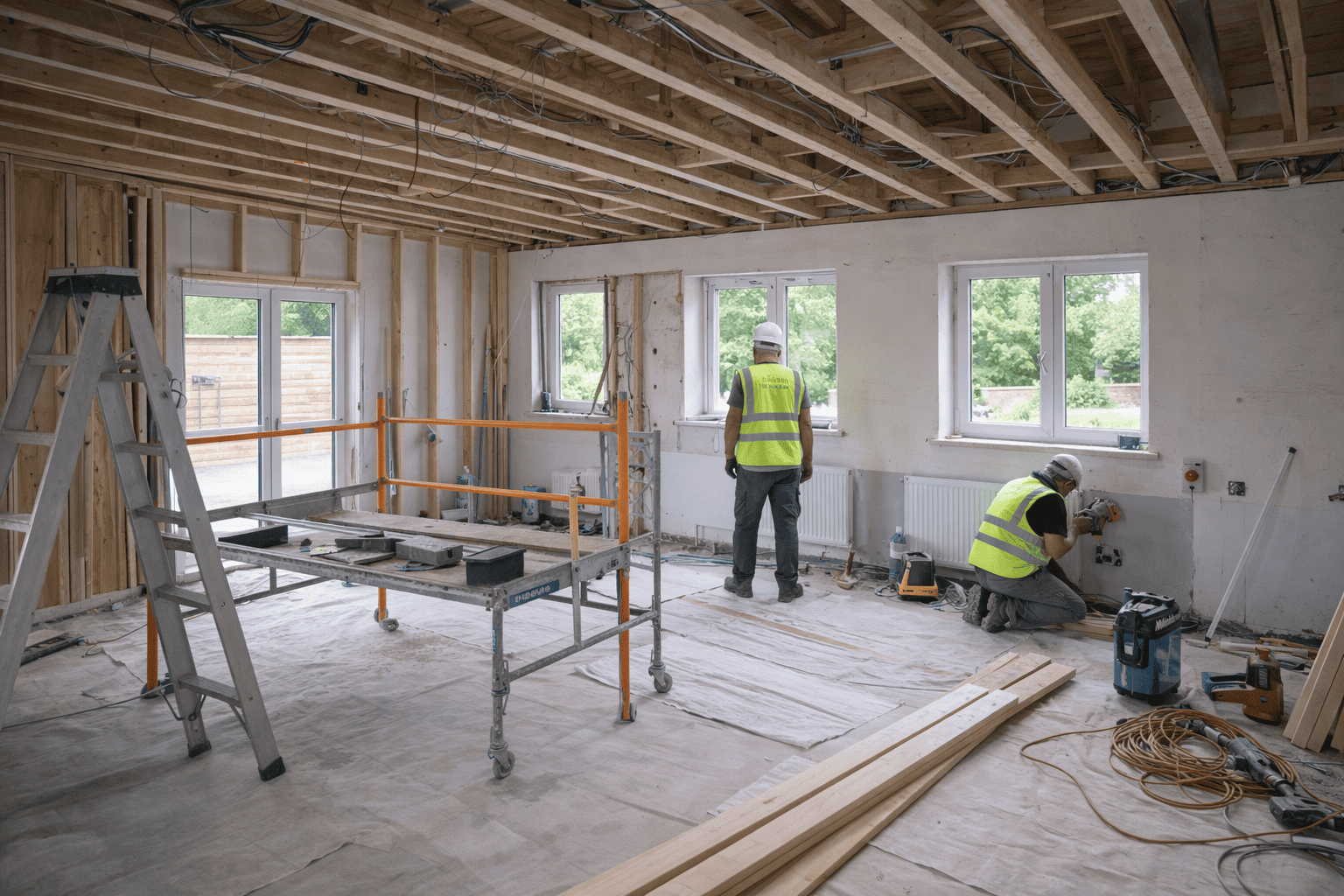
We carry out full and partial refurbishments on live sites. This includes wet room installations, bedroom upgrades, redesigning communal spaces, fire safety improvements, kitchen upgrades to meet HACCP compliance, and M&E overhauls. We plan all work to avoid disrupting residents and care delivery.

Care Home Extensions

For operators with an existing Warwickshire site, extending the building is often the quickest way to increase registered bed capacity. You do not need to start from scratch with land or planning history. You are adding to a site that already operates and is familiar to local commissioners.
We design and deliver extensions that fit with the existing building and meet current CQC and Part M requirements. We phase the work so the home can keep running during construction. There is high demand for residential beds in Rugby, Nuneaton and Bedworth, and for nursing beds across the county. New capacity is often filled quickly when it becomes available.

Dementia and Later Living

The need for dementia care in Warwickshire is a strong reason to invest in the county. In 2020, about 8,760 people in Warwickshire were living with dementia. This number is expected to rise to 11,227 by 2030 and nearly 13,721 by 2040, representing a 57% increase over 20 years. The county council's strategy highlights dementia as a leading cause of death for women aged 65 and over.
We design and build dementia units and later living facilities using DSDC design principles. Our layouts support wayfinding and help reduce agitation. We use appropriate lighting and contrast, provide secure outdoor access, and include staff sight lines in the floor plan from the start. Good dementia design has a direct impact on CQC ratings, NHS placement income and long-term occupancy stability.
care-home-refurbishment1.jpg

The Warwickshire Care Market: What the Data Shows

A Rapidly Growing Elderly Population and Rising Social Care Spend to Match

Warwickshire's over-65 population is expected to increase from 122,000 in 2020 to 145,500 by 2030, a 19% rise over ten years. By 2035, the number is projected to reach about 157,600, a 29% increase from 2020. The 75-and-older group, who are most likely to need residential or nursing care, is expected to grow by 30% by 2030.
The county council's Adult Social Care Strategy (2025–2030) shows the impact of these changes: social care spending has increased by 53% over five years and is expected to reach £227.1 million in 2024/25. By January 2025, the council was supporting 7,662 people, which is 13.1% more than at the end of 2018/19. The average cost of care home placements also rose by 6.1% in just ten months. The system is under strain, and the situation is worsening.

Dementia Demand Is a Specific and Growing Gap

The dementia figures are significant on their own. The number of people with dementia in Warwickshire is expected to rise from 8,760 in 2020 to 11,227 by 2030 and 13,721 by 2040. This is a 57% increase over 20 years. The Warwickshire Adult Social Care Strategy highlights dementia as one of the main conditions increasing complexity and cost in the county's care system.
Building a well-designed dementia home or a dementia unit within a new mixed-care facility is one of the best commercial opportunities in this market. NHS-commissioned dementia nursing placements bring in higher fees than standard residential care, occupancy is usually more stable, and demand for this type of care is growing faster than for any other care type in the county.
care-home-refurbishment-uk1 (1).png

Supply Pressure Is Uneven and Most Acute in Specific Areas

Warwickshire's care home market does not face the same level of pressure across the board. According to the county council's sufficiency data, the greatest shortage of residential beds is in Rugby, Nuneaton and Bedworth, and Stratford. For nursing beds, the biggest pressure is in Nuneaton and Bedworth. These are the areas where commissioners struggle most to find placements, and where a well-designed new build or extension is most likely to fill quickly.
Stratford-on-Avon, on the other hand, has the highest number of nursing beds per 1,000 people in the county, at 24.2. However, even in areas with more beds, the quality of existing facilities varies a lot. As the 75-and-older population grows across the county, even well-supplied districts will see increased demand.

Framework Rates Are Under Pressure, but Self-Funders Are Present

The county council's data shows that only 28% of residential placements and 11% of nursing placements are currently at the framework rate. This highlights how difficult it is for commissioners to fill beds at rates that operators can manage, and why income from self-funders is so important to the financial model of a Warwickshire care home.
Warwickshire has a mixed demographic. Affluent areas such as Royal Leamington Spa, Kenilworth, Stratford-upon-Avon, and Warwick have a strong base of self-funders who can pay premium weekly fees. These locations are ideal for purpose-built new facilities with en-suite wet rooms and modern communal spaces, which can stand out from existing options and justify higher private rates.

Central Location and Strong Transport Links

Warwickshire is truly central. The M40, M6, M42, and A46 all pass through or near the county. You can travel from Leamington Spa to London Marylebone in under 80 minutes by train. Birmingham is just 30 minutes from Warwick, and Coventry is nearby. This level of connectivity is important for recruiting staff, which is one of the most critical factors for a new care home, and for making it easier for families to visit, which helps with occupancy and resident retention.
University Hospital Coventry and Warwick Hospital are both easy to reach from most parts of the county. This helps with NHS discharge pathway relationships and supports the clinical referral networks that fill beds with funded placements
care-home-contractors-uk3.jpg

Building Care Homes Across Warwickshire

Warwickshire offers a strong environment for care home development, with each district presenting distinct opportunities. Population growth and an ageing demographic are driving ongoing investment in care accommodation. We work across Warwickshire to help developers, investors, and operators identify suitable sites and deliver care homes that meet current and future needs.

Warwick District

The Warwick district, which includes Leamington Spa, Warwick, Kenilworth, and Whitnash, is among the county’s most affluent areas. High homeownership and wealth lead to a large proportion of self-funding residents, making the area suitable for premium residential and nursing care developments.
Leamington Spa has an established care market, with many homes achieving premium weekly fees. Warwick and Kenilworth continue to offer opportunities for new developments aimed at private residents. The district’s transport links via the M40 and direct rail services provide good access for staff, visitors, and healthcare professionals.

Stratford-on-Avon District

Covering Stratford-upon-Avon. This district includes Stratford-upon-Avon, Alcester, Shipston-on-Stour, and Southam. It combines market towns and rural communities with an ageing population and strong demand for later-life accommodation. Despite having one of the highest numbers of nursing beds per 1,000 residents in Warwickshire, there is still recognised pressure on residential care provision. The area’s affluent demographics create an excellent environment for private-pay care homes, while continued housing growth is expected to increase future demand.

Rugby Borough

Rugby, along with Dunchurch, Hillmorton, and Long Lawford, is one of the county’s fastest-growing areas. Ongoing residential development is increasing the older population and demand for care services.
Local studies show ongoing pressure on the supply of residential care beds, creating opportunities for new developments. Rugby’s connectivity via the M6, M45, and A45, and its proximity to University Hospital Coventry, make it a suitable location for residential and nursing care schemes.

Nuneaton and Bedworth

Nuneaton, Bedworth, and nearby communities continue to face high pressure on nursing care provision. Demand is driven by a growing ageing population and many residents requiring publicly funded care.
Although the local demographic differs from that of more affluent districts, there is potential for modern nursing homes to support NHS referrals and local authority placements. Facilities that deliver high-quality clinical care are well-positioned in this market.

North Warwickshire

North Warwickshire, which includes Atherstone, Coleshill, Polesworth, and Dordon, is one of the county’s most underserved care home markets. Provision is limited, especially in rural communities, creating opportunities for new developments.
The district is seeing housing growth and new later-living communities, which support the case for further care home investment. Access to the M6 and M42 provides convenient transport links for staff, suppliers, and visiting families, and supports daily operations.
care-home-contractor-uk3.jpg

How we work

Beginning with the initial contact, we guide you through the entire process from start to finish:

1. First Contact (Initial Call) - We discuss your project, location, services, number of beds, budget, and time scale. We will give it to you straight on how viable your project is, along with a fair cost estimate and an overview of the planning situation in your District.

2. Assessments - Feasibility & Site Review - We review both the site/or current building and its feasibility as an NHS development: The planning environment, costs, time scale, and what the Local Commissioner Market can realistically support. No obligation at this point.

3. Designs & Planning - Our Healthcare Architects create CQC-compliant floor plans based on HTM/HBN guidance & Part M requirements. We will also oversee the Pre-Application Engagement & Planning Submission with the appropriate District/Borough Council.

4. Build & Project Management - We will carry out all aspects of Construction, Structural, Mechanical/Electrical and Fit-Out. There will be a designated project manager to keep you informed of the project's progress and issues that may arise.

5. Delivery & Commissioning - We provide a CQC Registration Ready Facility and are available to assist with snagging and further support after completion.

FAQ

Where are the best locations to develop a new care home in Warwickshire?

-
There is no one-size-fits-all answer, as the best location depends on the type of care home you want to build and the needs of your future residents. For developers targeting the private-pay market, Leamington Spa, Warwick, Kenilworth and parts of Stratford-upon-Avon are among the county’s most attractive locations. These areas have relatively affluent populations, higher levels of home ownership and greater demand for premium accommodation, making them well-suited to purpose-built residential, nursing and dementia care homes.
In other parts of the county, Rugby is seeing more demand for residential care as new housing developments bring in more people. Nuneaton and Bedworth also offer good opportunities, especially for nursing care and homes that partner with local authorities and the NHS. Some rural areas in North Warwickshire still lack sufficient modern, high-quality care homes, leaving room for new developments. Before starting any project, it is important to carry out a detailed feasibility assessment. This should look at local demographics, current care home supply, planning policies, competition, and long-term demand.

Is there enough demand for premium care homes in Warwickshire?

-
Yes, particularly in the county’s more affluent towns. Towns like Leamington Spa, Warwick, Kenilworth, and Stratford-upon-Avon have the right demographics for premium care homes. Higher property values, more household wealth, and more self-funding residents make these places a good fit for high-quality, purpose-built care homes with better accommodation and facilities.
But Warwickshire is not just one market. In places like Nuneaton and Bedworth, more care home places are funded by local authorities and the NHS, which creates different opportunities for care home operators. Both private and public funding models can work well, but each needs its own business plan, financial planning, and operating approach.

Does existing care home capacity mean Warwickshire is already well served?

-
Not necessarily. Vacancy numbers do not tell the whole story. Just because a bedroom is empty does not mean there is enough capacity. Occupancy depends on factors such as building quality, location, CQC ratings, room size, and services provided.
Older care homes with outdated designs may struggle to attract residents. In contrast, new, purpose-built homes that meet current expectations typically have higher occupancy rates. Demand also changes across Warwickshire, with some areas needing more residential care and others needing more nursing care. It is much more useful to understand demand at the district level rather than just county-wide statistics.

Which planning authorities oversee care home developments in Warwickshire?

-
Planning applications are managed by the county’s five district and borough councils:
  • Warwick District Council
  • Stratford-on-Avon District Council
  • Rugby Borough Council
  • Nuneaton and Bedworth Borough Council
  • North Warwickshire Borough Council
Each council has its own Local Plan, planning rules, and development priorities. This means you need to carefully assess each site before submitting an application. We handle the entire planning process for our clients, from feasibility studies and early discussions through planning submissions, technical design, and construction. Talking to the local planning authority early on can help spot potential problems before they cause expensive delays.

How much does it cost to build a new care home in Warwickshire?

-
Construction costs depend on the project size, building specifications, ground conditions, and the type of specialist care you plan to offer.
As a general guide, purpose-built care homes in the Midlands typically cost between £2,800 and £4,500 per square metre to construct. A modern 60-bed care home may require a construction budget of approximately £7 million to £12 million, excluding land acquisition, professional fees, planning costs and internal furnishings.
One benefit of building in Warwickshire is that land prices are usually lower than in London or the South East. This can make new developments more financially viable. We create detailed feasibility studies and cost plans for each project. This helps our clients make informed investment decisions based on the current market, not just general industry averages.

Let’s get
started

Would you like to learn more about how we can help you with your next residential or commercial project, fill in your details and a member of our team will be in touch.

This site is protected by reCAPTCHA and the Google Privacy Policy and Terms of Service apply.

Latest From the Blog

care-home-extension-kent2.png
How to Extend an Existing Care Home in the UK: Planning, Cost, and Process (2026)

  Most operators increase capacity by extending their existing care homes rather than building new ones. Last yea..

Read Full Story »
care-home-builders-kent2.png
Buying an Existing Care Home vs Building New: The Real Numbers

It's the question every care home investor and operator eventually faces. You've decided to enter the sector or to grow your portfolio. Now you have to choose: do you buy a care home that's already trading, or do you build one from the ground up? ..

Read Full Story »