Care Home Builders Surrey

We build care homes in Surrey (new builds, extensions and refurbishments all under one contract). Our QS prices the job from day one, so you know the cost before you commit to a site or a design. Then we build it. Surrey is one of the strongest care home markets in England, but it's not an easy market to operate in. Most residents pay for themselves; fees are high, and the older population is growing. Land is expensive, planning is difficult, and the Council's own data shows that some types of beds are in deficit and others are not. This page sets out what the data tells us, where the gaps are, and how we would build.

Care Home Developers Surrey

What we do in Surrey 

We build four types of projects. Each one begins with a cost check by our QS team before any design money is spent.

New build care homes

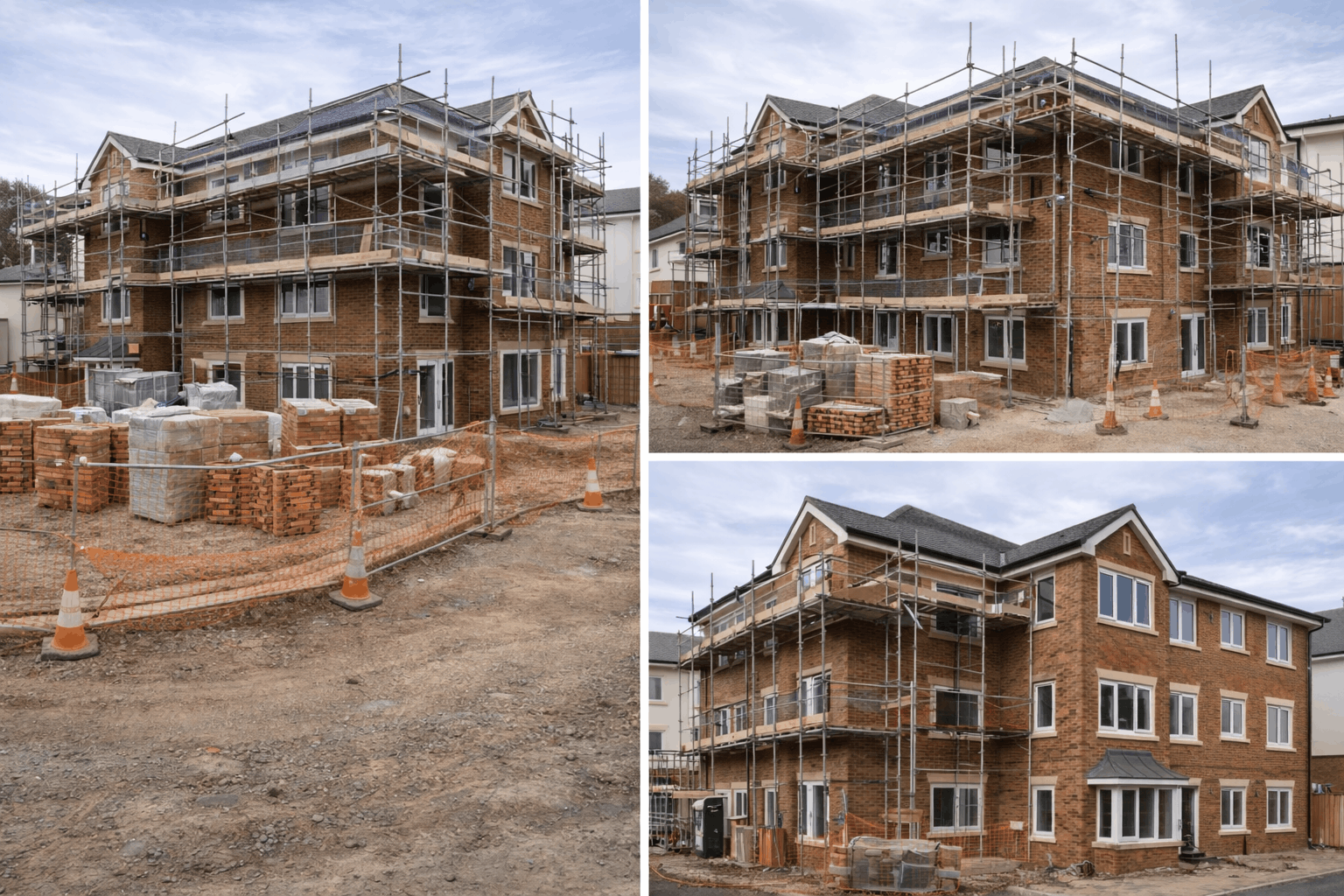
We take a home from feasibility through to handover. We do the design, price it at each stage, do the build, and deliver a finished home. In Surrey, the biggest risk is, of course, cost (land and build costs are high, and the site is often awkward). We price early so you know whether a site is viable before you commit.

Care home extensions

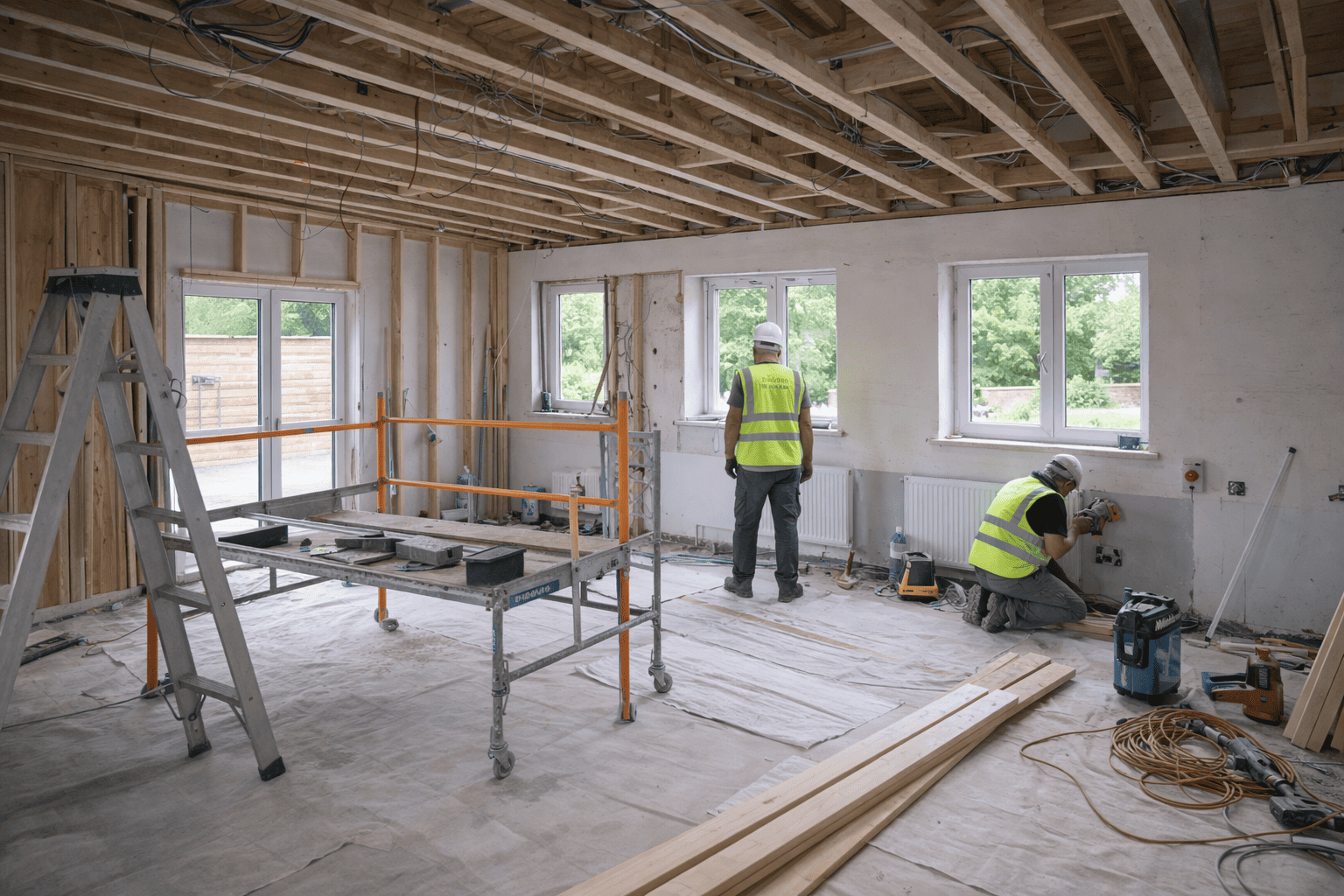
An extension is often the quickest way to get the beds on the site, since the registration and commissioner relationships are already in place. Most of the extensions in Surrey are carried out whilst the house is still occupied. We work around the residents, the fire compartments, and the kitchens.

Care home refurbishment

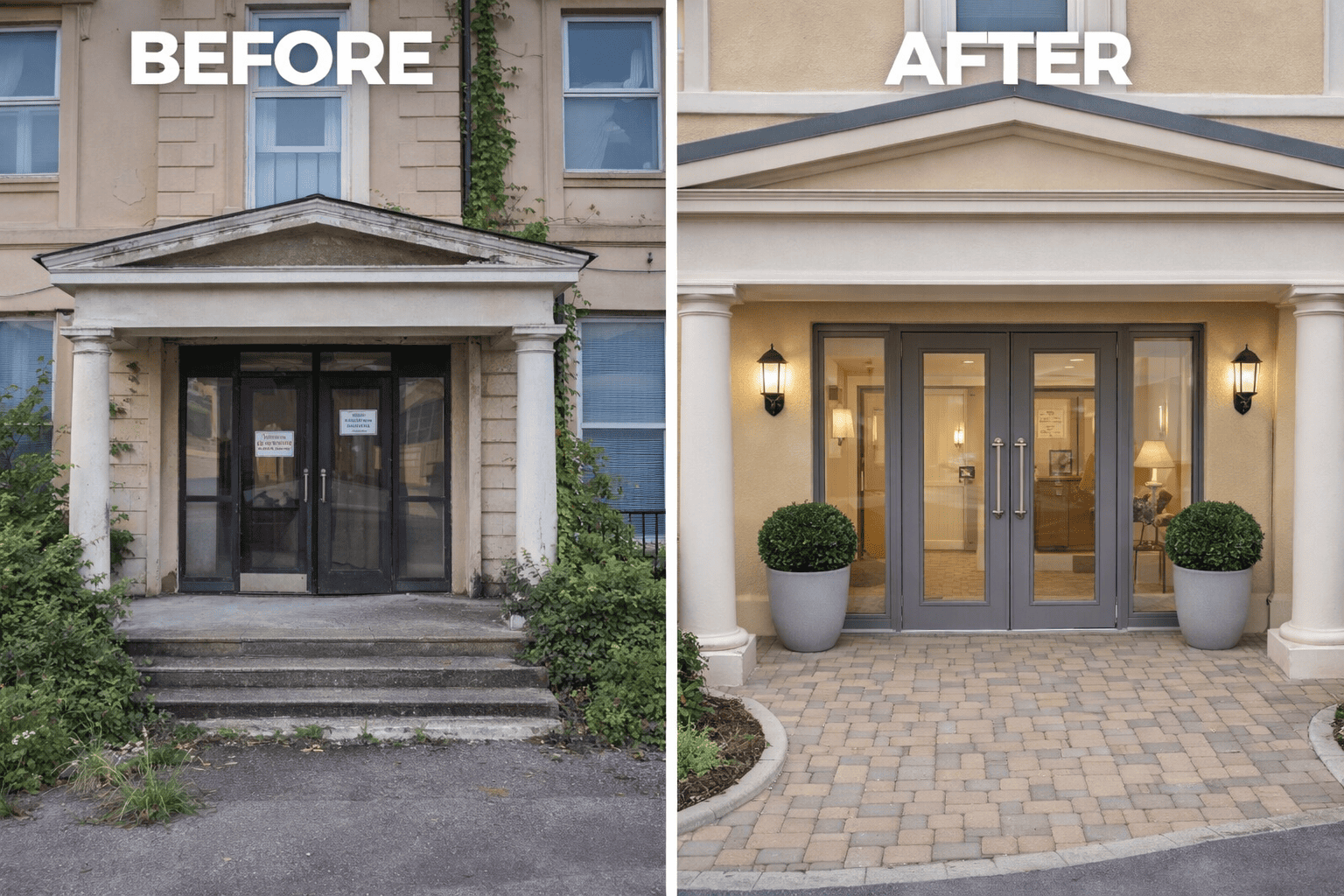
Lots of the homes in Surrey are older converted properties, and the usual problems are with the M&E (mechanical and electrical), bedrooms without wet rooms, rather tired layouts, and fire safety. We do the refurbishments in stages whilst the house is still in use. Self-funders will conduct a very thorough comparison of the homes, so a better-built home will improve your rating and the fee you can charge.

Dementia and later living

Surrey's own projections are that dementia will be up by around 28% between 2020 and 2030. Dementia units need to have clear layouts, safe access to the garden, good light, and good staff sightlines. All of these things are built in from the outset rather than being an afterthought.
care-home-extension-surrey1.png

The Surrey Care Home Sector

Self-funders drive the market

The Surrey County Council Market Sustainability Plan states that 60-65% of the 65+ care home places in the county are sourced by self-funders. A letter to providers from the Council in 2021 stated that it was only spot purchasing circa 15% of the beds. The new homes are being built with that market in mind, and the Council notes that the major operators in the county are very much focused on it.

The Council pays far less than residents do

For 2025/26, the Surrey County Council guide price for residential care is £806.45 per week, and £930.25 per week for nursing care (plus funded nursing care). Their own 'cost of care' page has average self-funded fees of c£1,450 per week for residential care and c£1,695 for nursing (2026, source: Lottie). That's a gap of circa 80%.
This is absolutely critical when you're planning a build. A Surrey home that depends on council-funded beds is going to find it extremely difficult. A home built for self-funders has to provide the rooms and communal spaces that self-funders are prepared to pay for, which comes at a higher build cost.

The population is ageing

Using the Council's POPPI figures the 65+ population rises from 231,800 in 2020 to 281,000 in 2030 and 307,600 in 2035. The Council's Strategic Context document states that the number of people aged 85 and over will increase by 29% by 2030. People over 85 are the group most likely to need a care home.
care-home-extension-surrey3.png

The Council says the gaps are uneven

In Oct 2025, Surrey County Council published its planning profiles for each borough and district, comparing local bed numbers with the England average. They don't say 'build anything anywhere'. A number of areas (Mole Valley, Spelthorne, and Surrey Heath, to name but a few) are identified as needing more residential beds. A number of the profiles also note that in various areas, nursing beds are either well supplied or oversupplied.
The opportunity isn't equal across the county or across care types. Before you buy a site, you need to review the planning profile for that borough. We'll do that as part of the first cost check.

Things that make Surrey harder

We'd rather you heard these from us first. Land is very expensive. A large proportion of the county is Green Belt, and the Surrey Hills AONB covers a lot of the south. There are a number of sites in the vicinity of the Thames Basin Heaths that will require additional ecological mitigation. Staff costs are also very high as so many of the staff just can't afford to live in the area. It is all very much a good scheme, of course, and the numbers will have to be checked prior to purchase.
care-home-refurbishment-surrey2.png

Our Five-Step Design and Build Process

From feasibility through to final handover, we manage the entire process of your care home development, bringing together specialist design, commercial, and construction delivery in a single integrated approach.

1. Initial Feasibility & Cost Assessment

Just send over your architectural drawings, proposed development plans, or site information, and our in-house Quantity Surveyors will carry out a free initial cost assessment. This will give you a clear idea of the likely construction costs, financial viability, and commercial potential of your project before any major decisions are made.

2. Appointing the Right Design Team

Every care home development will have its own set of operational, regulatory, and design requirements. We put together a suitably experienced professional team for your project (including an ARARB-registered care sector architect with the requisite sector experience) along with the appropriate engineering and technical consultants.

3. Design Development & Planning

We manage the design process, the planning application, and the technical development of your scheme. At each stage of the design, our Quantity Surveyors review and update the construction cost to keep the budget under control, identify potential savings, and avoid unforeseen expenditure.

4. Construction & Project Delivery

Once the design is final and all the necessary approvals are in place, the construction team takes on the project. We deliver via a single construction contract with dedicated project management and one principal point of contact, thereby providing clear lines of accountability, co-ordinated delivery, and consistent communication throughout the build.

5. Completion & Handover

We carry out the final inspections, testing, commissioning and completion documentation prior to handover of your finished care home. Our objective is to deliver a safe, compliant and fully operational building, with all the required construction information to support your CQC registration and your preparations for opening.
care-home-builders-surrey1.png

What Drives the Cost of a Care Home in Surrey

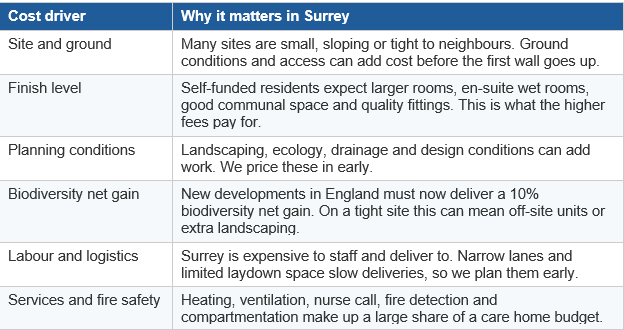
The cost of building a care home in Surrey will be determined by several factors, including the site's location and condition, the development's size and design, the accommodation specifications, and regulatory requirements.
Surrey presents a whole host of construction issues in terms of site availability (very restricted), the complexity of the planning process and the higher expectations in relation to premium care accommodation. It's absolutely vital that you have a clear understanding of these at an early stage to arrive at a realistic construction budget and avoid the sort of nasty surprises that can arise as the project unfolds.
At Care Home Builders, our in-house QSs look at all of that during the feasibility stage so they can help the developer or care operator to make a proper investment decision prior to any construction taking place.
care-home-refurbishment-surrey4.png

How We Build Care Homes in Surrey

Building next to residents

Many of the jobs in Surrey are extensions or refurbishments to homes, with a stay-in-place option that remains open. That has a bearing on how we build. We work with the manager to agree on a phasing plan prior to starting. We keep the site separate from the residents and visitors, protect the fire escape routes, and keep the noise and dust away from the bedrooms and dining areas. We plan deliveries around meal times, visiting times, and shift changes.

Fire safety and compartmentation

Care homes are designed so that the residents can stay in place whilst the fire is dealt with in one area. That is down to fire doors, compartment walls, and detection all working together. In a refurbishment, you'll often find the old work has been hidden behind the finishes. We look for it early so it doesn't become a surprise cost later on.

Ready for CQC registration

A home won't be able to open or add beds until the provider has the correct registration. We build to the brief your care team gives us, so the bedroom and wet room layouts, handrails, door widths, nurse call, sluice rooms, laundry, kitchen, and storage are all specified. We also agree a snagging and handover plan so that you can open on time.

Comfort and running costs

Residents are often in the building all day, so heating and cooling are very important. New residential buildings are now required to comply with the overheating requirements in Part O of the Building Regulations. We look at ventilation, glazing, and heat right from the outset, as it's far cheaper to address them at that stage than to go back and do so later. A well-insulated building will also be less expensive to run.

Dementia-friendly design in practice

Good dementia design is essentially about simplicity. Clear routes, no dead ends, lots of daylight, contrasting colors on the doors and the floor, and safe access to a garden. Staff should be able to see down the corridors and into the communal areas. All of that is relatively cheap to get right from day one and very expensive to retrofit later.
care-home-extension-surrey2.png

Planning in Surrey - What to Check First

Planning permission is by far the most important consideration when looking at developing a care home in Surrey. The Green Belt, protected landscapes, flood risk, and local planning policies will all affect what you can build, how many bedrooms you can achieve, and the overall feasibility of the project.
At Care Home Builders, we work with experienced architects and planning consultants to identify potential constraints early on so that the developer can make an informed decision before they buy the land or commit to building.

Green Belt Restrictions

Much of Surrey is within the Metropolitan Green Belt, and development there is very tightly controlled. Extensions, replacement buildings and redevelopment of existing sites may be possible in certain circumstances depending on the local and national planning policies.

Surrey Hills National Landscape

Sites which are within the Surrey Hills National Landscape or which have an effect upon it will be subject to additional planning scrutiny. The design, scale, materials, and landscaping of any proposed development will be required to be sensitive to the surrounding environment.

Thames Basin Heaths Protection

Developments in the vicinity of the Thames Basin Heaths Special Protection Area may be subject to ecological assessments and mitigation. The exact requirements will depend on the site's location and the type of care accommodation in question.

Flood Risk and Drainage

Sites in and around rivers in Surrey, as well as flood-prone areas, will need to be assessed. Care homes are generally considered to be more vulnerable developments and, as such, will require a flood risk assessment and appropriate drainage.

Conservation Areas and Listed Buildings

Developing or converting properties within conservation areas, or those involving listed buildings, can bring further restrictions. The heritage considerations will have to be balanced against the requirements of accessibility, fire safety, and modern care.

Highways, Access, and Parking

Care homes will need appropriate access for staff, visitors, deliveries, and emergency vehicles. The provision of parking, the arrangements for servicing, and the condition of the surrounding roads can all affect both planning approval and the actual site layout.

Local Demand for Care Accommodation

Evidence of demand for residential, nursing, or dementia care can support a planning application. The local authority's care market assessment, population projections, and current level of care provision should all be considered to establish the need for additional care.

Assessing Your Site Before You Invest

Planning restrictions can have an impact on development potential, construction cost, and project timescales. It's important to identify these early in order to mitigate financial risk and determine whether the proposed care home is commercially viable.
Care Home Builders can help you assess the construction feasibility of your site by working with specialist planning and design consultants to identify any potential problems before development commences.
Planning a care home in Surrey? Get in touch with us for an initial feasibility and construction cost assessment.

FAQ

Do you handle design as well as build?

-
Yes, we run the design and build as a single job. The drawings are produced by an ARB-registered architect (who will have care home experience), and you can check any architect on the Architects Register. We price each stage so the design stays within your budget.

Can a home survive in Surrey if it's only for council funded residents?

-
It's very difficult. The Council's 2025/26 guide price is £806.45 per week for residential care; average self-funding fees are around £1,450 per week. The vast majority of the successful Surrey homes are built for the self-funder market, with only a very small number of council beds, if any. We can model this for you prior to you buying a site.

Which parts of Surrey have the strongest case for a new home?

-
Start with the Council's October 2025 planning profile for the borough in question. Mole Valley, Spelthorne, and Surrey Heath are all identified as being in need of more residential beds. Nursing beds appear to be well provisioned in certain areas of the county, so a nursing-only scheme would require more care. We'll go through that profile with you.

How difficult is planning in Surrey?

-
t depends on the site. Green Belt sites will require very special circumstances. Sites in or adjacent to the Surrey Hills AONB will require a very strong design. Sites adjacent to the Thames Basin Heaths may require some form of ecological mitigation. Sites within the settlement boundaries are generally the easiest. We tell you right at the outset what category your site falls into.

Should I refurb my existing Surrey property or rebuild?

-
It's all down to the structure. If it can cope with wet rooms, larger bedrooms, and a better layout, then a refurb is usually the cheaper and faster option. If it can't, then a rebuild may be the better route. Our free cost check will give you both figures.

Can you build whilst our home is still open?

-
Yes. Most of the Surrey extensions and refurbishments are carried out in this manner. We would, of course, have a phased plan in place with your manager, keep the work areas separate from the residents, and ensure fire routes are protected. We would plan any noisy work and deliveries around meal times and visiting times.

How much does it cost to build a care home in Surrey?

-
t varies from site to site, depending on the size and the finish. We don't quote you a price per bed as that would be misleading. Send us your drawings/site details and our QS team will provide you with a genuine figure. The cost check is absolutely free.

Do you help with the design and planning or are you just the build people?

-
We do design, planning support, and the build as one job. You deal with us, and we take care of the architect, the engineers, and all the other consultants.

What do you need in order to give me a cost?

-
Drawings are best (even the early ones). If you've got nothing yet, then just send us the site address, the number of beds you're after, and the type of care, and we'll be able to give you an early view from that.

Let’s get
started

Would you like to learn more about how we can help you with your next residential or commercial project, fill in your details and a member of our team will be in touch.

This site is protected by reCAPTCHA and the Google Privacy Policy and Terms of Service apply.

Latest From the Blog

care-home-extension-berkshire2.png
Fire Safety and Sprinklers in Care Homes

Fire safety is one of the areas that catch care home developers out most. It's not that they ignore it at all, it's that they simply don't appreciate how different fire safety is in a care home environment to a standard residential or commercial building. ..

Read Full Story »
care-home-extension-kent4.png
Grey Belt and Care Home Planning: What the 2026 NPPF Changes Mean for Developers

Land is the scarcest input in care home development. Particularly in the South East, where demand is highest and supply is tightest, the sites that make economic sense are often inside or adjacent to the Green Belt. For most of the last four d..

Read Full Story »